
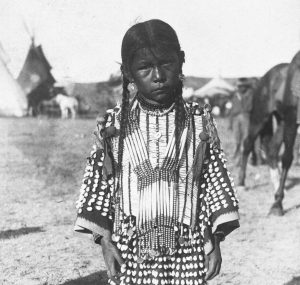
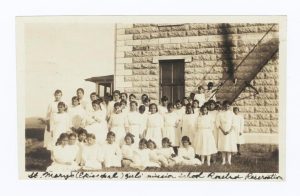
“At first [the girls] are shy, but when really acquainted, they are very affectionate and cunning. All have made good progress in English this year, far better than before. A special effort was made to banish Dakota. They were allowed to talk it only on Sundays, but before the end of the year, very little Indian was heard even then.”
Mrs. Burt reports from the Crow Creek Agency, South Dakota for the Episcopal Church publication, The Spirit of Missions.
Dear Trinity Church and friends,
American Indian boarding schools were a network of government- and church-run institutions established from the 19th through the mid-20th centuries to assimilate Indigenous children into Euro-American society. Some institutions operated under a guiding principle of “Kill the Indian, Save the Man.” The system sought to eradicate traditional Native languages, spiritual practices, and tribal structures. In this way, a hostile “vanishing race” could be saved using Euro-centered education and Christianity. The policy was driven by federal initiatives such as the Civilization Fund Act of 1819 and subsequent legislation through the late 1800s, including President Ulysses S. Grant’s Peace Policy.
The policy aimed to move Indigenous people onto protected reservations, abandon nomadic lifestyles, and adopt European-American culture, farming, private property, and Christianity. It also sought to eliminate corruption in the existing federal Indian Bureau. This confinement to reservations coincided with massive waves of white westward expansion (Manifest Destiny), the completion of the Transcontinental Railroad, and the near destruction of the buffalo herds that sustained Plains Indian economies.
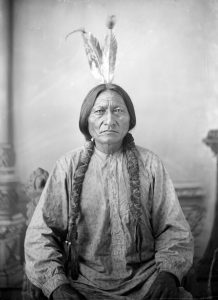
When tribes resisted confinement, or when the U.S. government failed to uphold treaties, the policy relied heavily on the U.S. Army to subdue “hostile” groups, leading to mutual massacres and brutal conflicts like the Battle of the Little Bighorn. This battle was fought on June 25–26, 1876, near the Little Bighorn River in Montana Territory, and resulted in a decisive victory for a coalition of Lakota Sioux, Northern Cheyenne, and Arapaho warriors, led by leaders Sitting Bull, Crazy Horse, and Chief Gall, among others, against the U.S. Army’s 7th Cavalry Regiment. The defeat stunned the American public and triggered a massive escalation in U.S. military presence. “Civilizing the red man,” for profit or otherwise, became a national priority.
Legislative acts set the legal and financial foundation for church-state collaboration in assimilating Indigenous children and adults. The government partnered with, and financially subsidized, Christian missionary organizations and charitable societies to operate schools on or near Native territories. The Episcopal Church formally began administering more than 30 boarding schools, primarily in the 1870s (though earlier efforts existed), and provided monetary and other support to additional schools across the country.
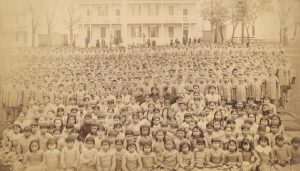
More than 526 federal- and church-run boarding schools operated across dozens of U.S. states and territories. Between 1869 and the 1960s, many thousands of Indigenous children were removed from their families. The first prominent off-reservation model was the federally operated Carlisle Indian Boarding School, founded in 1879 in Pennsylvania. Children from hundreds of tribes across the country were sent to this school.
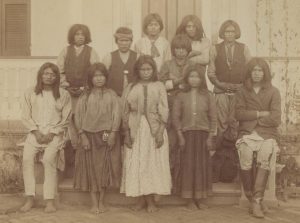
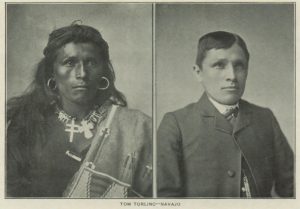
Some of the most illuminating photos of the boarding school experience are from Carlisle, where the director, Captain Henry Pratt, hired a photographer, John Nicholas Choate, to take so-called before-and-after pictures as fundraising advertisements for the school’s success in civilizing.
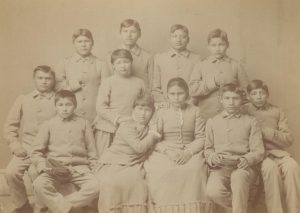
Of the 30-plus boarding schools operated by the Episcopal Church, the largest concentration of these Episcopal-associated institutions was in South Dakota, including:
- St. Elizabeth’s Boarding School for Indian Children (St. Elizabeth’s Mission School): Located in the Wakpala area on the Standing Rock Reservation.
- St. Mary’s Episcopal School for Indian Girls: Founded in 1873 on the Santee Indian Reservation in Nebraska, it moved to the Rosebud Reservation in South Dakota after fires and later relocated to Springfield, South Dakota.
- Yankton Mission / Emmanuel Hall and other regional Niobrara/Hare mission schools across South Dakota’s reservations (such as Crow Creek and Yankton/Yanktonnais).
- All Saints School: Founded in 1884 in Sioux Falls, South Dakota, by Bishop William Hobart Hare as an Episcopalian boarding school.
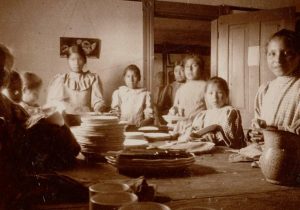
Trinity Church Year Books were produced, more or less annually, as a way to report and remind the parish of what it had done the prior year. These books provided a snapshot of parish activities, including its support of mission work both domestic and foreign. Over time, they became increasingly detailed in the information they conveyed. For instance, an 1876 report of services and contributions noted that $1,323.20 (more than $40,000 in today’s dollars) had been collected for the Episcopal Indian Mission. In later Year Books or Annual Reports, different ministries within the church reported in detail how much had been collected and contributed to various efforts, local, national, and abroad. In 1882, the Sunday School reported the following:
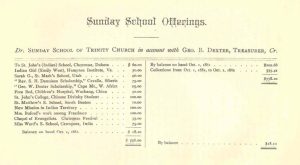
Regarding the Indian Mission, the Sunday School raised $60 to support St. John’s Indian School in Cheyenne, Dakota; $100 for the New Mission in Indian Territory; and $70 for a Dakota “Indian girl” named Emily West to attend Hampton Institute in Virginia.
Founded in 1868, Hampton had been operating as an educational institution for Black students. In April 1878, Hampton founder General Samuel Chapman Armstrong entered into an agreement with the federal government to expand the school’s mission to include Indigenous students. In addition to federal funding, a $60-$70 ($2000-$2300 in today’s dollars) donation was enough to sponsor a student’s enrollment.
In that same Year Book, Trinity’s Industrial Society, which employed women to sew garments that were then sold, reported sending remainder garments to the local poor and to an Indian girls school in Santee, Nebraska. The Employment Society offered 75 articles of clothing to the Indian Mission. The Thursday Evening Sewing Society reported that, from its Christmas Fair, it was able to offer a $60 Indian scholarship.
The Dakota League was a 19th-century women’s missionary association founded in 1863 at Emmanuel Church in Boston to fund and support Episcopal missions among Indigenous nations, particularly the Dakota people. The organization grew directly out of early Episcopal outreach following the U.S.–Dakota War of 1862. Parishioner Mary Douglass Burnham (1832–1904) organized the society after members of an Emmanuel Sunday-school class were moved by an address from Minnesota Bishop Henry Benjamin Whipple regarding the welfare and mission work among the Dakota.
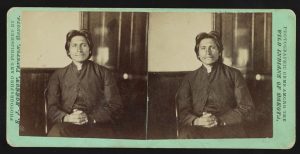
Formally organized with a President, Vice-President, Secretary, and Treasurer, the Dakota League served as a precursor to the national Woman’s Auxiliary to the Episcopal Board of Missions, which formed in 1871. The League’s first major pledge was raising $150 annually to fund the theological education of Paul Mazakute (Maza Kute), who became the first ordained Dakota priest in the Protestant Episcopal Church. Following his death, the Dakota League of Massachusetts published his memorial writings in Boston in 1874.
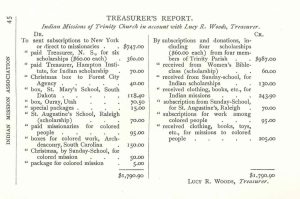
In 1895, Trinity Church appeared very vested in its Indian Mission work. Trinity’s Indian Mission, one of many missions under the umbrella of the Women’s Auxiliary, reported monies for scholarships in general, and to Hampton specifically, with boxes being sent to boarding schools at the Forest City Agency reservation, St. Mary’s School, as well as monies and boxes for the “colored people” in the South.
In 1910, Trinity’s Junior Women’s Auxiliary made children’s toys to send to boarding schools. Some money was raised for scholarships but not with the apparent fervor of years past. Records suggest increased attention to meeting local needs of the poor and aged. Also, the early 1900s was a period of widespread poverty in the American South, explaining why church records during this time show money and materials being sent explicitly to “poor whites” in that region.
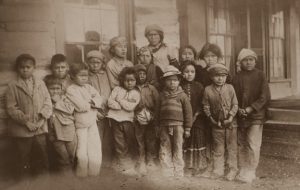
In records reviewed through 1930, Trinity Church did continue to give to the Episcopal Church Indian Mission as it existed at the time. Presentations by Episcopal preachers and lay people in Boston in the 1930s and 1940s, as reported in local newspapers, highlight a growing acknowledgment that the model of stripping Indigenous people of their culture was wrong. Chief Crazy Bull, a Hunkpapa Lakota Sioux, was just one of many Indigenous people who worked to correct that injustice and the misconceptions thereby engendered in society.
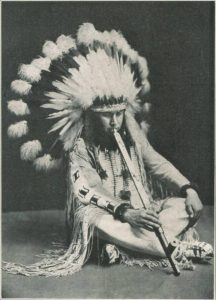
Chief Crazy Bull (Tatanka Witko), grandson of Sitting Bull, was born August 24, 1900, in Fort Thompson, South Dakota, on the Crow Creek Reservation. Both parents attended Hampton Institute in Virgina. At birth, he was baptized in the Episcopal Church as William Jacobs. As a child, he attended a federally operated reservation school in Pierre, South Dakota. Later, he attended Haskell Institute in Lawrence, Kansas, an off-reservation boarding school. He served in the 114th Cavalry, Troop C. Organized in May 1924 as part of the Kansas National Guard; the unit was composed entirely of students attending Haskell.
He graduated from Haskell in 1925. While continuing his studies on the East Coast, he lectured frequently. He became well known for giving cultural talks in traditional attire. During this period, he spoke before the Missionary Society at Trinity Church.
The Society regularly invited speakers to inform the parish about missionary work, provide updates, and share successes and challenges. These meetings took place in the Parish House. At that time, the Parish House consisted of two floors instead of the current four. The first floor was the Parish Library and the second floor, St. Andrew’s Hall, provided space for meetings.
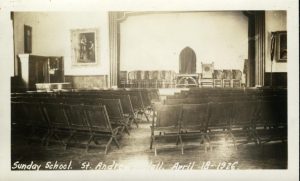
The 1930 Trinity Church Year Book reports that Chief Crazy Bull spoke:
“In full Indian costume he danced, and ended with an appeal for milk for the little Indian children at Wakpala, S. D. His friend, Revd. Brent Woodruff, is head of the school and is collecting a herd of thoroughbreds so that the children can have milk to drink. This is their best preventative against tuberculosis, from which so many Indians die in their teens. [Trinity’s] Miss Dorothy Harris was appointed chairman to collect $200, the price of a cow. Nearly $90 was given at the meeting. Miss Harris, with many of her friends, devised ways of raising the amount to $214.”
A striking figure in his Native garb, he drew attention from newspapers and periodicals that loved to chronicle his performances and presentations. Throughout his life, Chief Crazy Bull worked to dismantle clichés, stereotypes, and misconceptions surrounding Indigenous life and languages, including how his people were portrayed in film and in school textbooks. He died in 1952 and is buried in the Christ Episcopal Cemetery in Ft. Thompson, South Dakota. At one point in his life, someone asked why he sometimes titled his presentations as “The Indian of Yesterday and of Today.” What about tomorrow? He replied that “people didn’t seem interested in hearing about the Indian of tomorrow.”
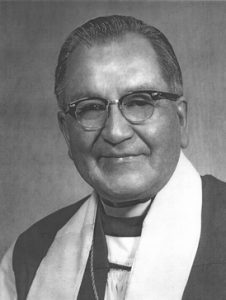
Forty-three years after Chief Crazy Bull spoke in the Parish House at Trinity, the Rt. Reverend Harold S. Jones, Suffragan Bishop of South Dakota, preached in the church. A Santee Sioux, he was the first American Indian Bishop in the Episcopal Church. And others have followed.
Today, Indigenous people talk about their own, their parents’, their grandparents’, and their great-grandparents’ experiences in the boarding school system. For some, it was brutal, with corporal punishment for speaking one’s language and so many other indignities. But even for those whose family memories are not ones of abuse, and are of receiving a good education, at what cost? As one person reflected, they were not always banned from speaking their tribal language, but given that fellow students were from so many other tribes, English was the only common language. Culture can be eroded in many ways.
Beginning in 2021, Presiding Episcopal Bishop Michael Curry and House of Deputies President Gay Clark Jennings issued a joint statement about the church’s historic involvement with the Indian schools, condemning cultural assimilation and abuse, and calling for a full reckoning. In 2022, the church voted unanimously to fund and launch a comprehensive, independent investigation into the Episcopal Church’s historical role. Following President Biden’s 2024 apology for Indian boarding schools, Bishop Curry, House of Deputies President Julia Ayala Harris, and Indigenous Episcopal leaders released a statement welcoming the apology and reaffirming their commitment to continue researching the church archives.
Until next month,
Cynthia
Sources and Further Reading
Barrett, Carole A. Thesis: Into the Light of Christian Civilization”: St. Elizabeth’s Boarding School for Indian Children 1886-1967.https://commons.und.edu/cgi/viewcontent.cgi?article=3709&context=theses
Kinkead, Eugene and Philip Hamburger. “Ugh, Ugh. Chief Crazy Bull, a Sioux educator and descendant of Sitting Bull, tries to correct Hollywood’s clichés about Native language and life.” The New Yorker. June 5, 1948, p.
MacDonald, G. Jeffrey. “Episcopal Church grapples with ‘transformative role’ in Native American residential schools.” The Christian Century. June 21, 2024. https://www.christiancentury.org/news/episcopal-church-grapples-transformative-role-native-american-residential-schools
Vigil, Jessica. “Columbia’s Role Call.”: Hampton Institute’s 1892 Pageant & The Native American Struggle for Citizenship. The Uncommonwealth. January 5, 2026. https://uncommonwealth.lva.virginia.gov/blog/2026/01/05/columbias-roll-call/
Warrington, Jancita. A Legacy of Sacrifice and Honor: Celebrating Tribal Resilience and Military Service at Haskell Nations University. Tribal College Journal of Indian Higher Education. Volume 29, No. 2 – Winter 2017. https://tribalcollegejournal.org/a-legacy-of-sacrifice-and-honor-celebrating-tribal-resilience-and-military-service-at-haskell-nations-university/
Other Online Resources
Battle of the Little Bighorn – This Day in History
https://dayinhist.com/battle-of-the-little-bighorn/
Hastiin Tohaali (Tom Torlino) with Gerilyn Torlino (Dine)
Indians at Hampton Institute. 1877-1923
https://www.jstor.org/content/oa_book_monograph/10.5406/jj.32726735
Library of Congress Classroom Materials
https://www.loc.gov/classroom-materials/native-american-boarding-schools/
National Native American Boarding School Healing Coalition
https://boardingschoolhealing.org/
Statement on Indigenous boarding schools by Presiding Bishop Michael Curry and President of the House of Deputies Gay Clark Jennings https://www.episcopalchurch.org/source/public-affairs/statement-on-indigenous-boarding-schools-by-presiding-bishop-michael-curry-and-president-of-the-house-of-deputies-gay-clark-jennings/
Episcopal Church leaders respond to President Biden’s apology for Indigenous boarding schools
Testimony to the Love of Jesus by Paul Makute
https://anglicanhistory.org/indigenous/mazakute1874.html
Newspapers
“Newton Archer Entertain Rivals.” The Newton Graphic. August 1927, p. 2.
“Crazy Bull Appears at Club.” The Churchman, volume 135, 1927, p. 23
“Sioux Indian to Entertain at Annual Affair in Y.” Worcester Telegram. December 29, 1927, p. 9.
“Red Men Tell Their Tales.” The Providence Sunday Journal Magazine. February 2, 1930, p. 29.
“Carry Good Cheer to Little Invalids, Jordan Marsh Entertains in Children’s Hospital.” Boston Herald. December 10, 1932, p.5
“Chief Bull to Speak to Episcopal Group.” Atlanta Journal. January 6, 1934, p. 5.
“Sioux Chieftain Votes; Crazy Bull in Tribal Regalia.” New York Times. November 8, 1944, 6.
“Indian Chief Objects to History Texts.” Knickerbocker News. September 13, 1945, p.16.
“Montana Seeks Real Redman.” The Post Register. May 25, 1956, p.
Images
“At Home.” https://catalog.archives.gov/id/313189956
“Sitting Bull.” By David F. Barry, Photographer, Bismarck, Dakota Territory – original period albumen print, Daniel Guggisberg historical photographs collection, Public Domain, https://commons.wikimedia.org/w/index.php?curid=49833987
“Chiricahua Apaches as they arrived at Carlisle from Fort Marion, Florida, November 4th, 1886. / Choate Carlisle, Pa.”. https://quod.lib.umich.edu/p/pohrt/x-1148/med069_001. In the digital collection Richard Pohrt, Jr. Collection of Native American Photography. William L. Clements Library, University of Michigan Library Digital Collections. November 13, 2026.
“Chiricahua Apaches Four Months After Arriving at Carlisle. / By Choate”. https://quod.lib.umich.edu/p/pohrt/x-1149/med070_001. In the digital collection Richard Pohrt, Jr. Collection of Native American Photography. William L. Clements Library, University of Michigan Library Digital Collections. November 13, 2026.
Tom Torlino Navajo
https://carlisleindian.dickinson.edu/images/tom-torlino-1882-and-1885
Paul Mazatuke
https://www.loc.gov/item/2016649559/
“Native American boys and girls at United States Indian Industrial School / Photographed by Choate, Carlisle, Pa.”. https://quod.lib.umich.edu/p/pohrt/x-767/large005_001. In the digital collection Richard Pohrt, Jr. Collection of Native American Photography. William L. Clements Library, University of Michigan Library Digital Collections. November 13, 2026.
“Navajo Children Ready to Enter School.” https://catalog.archives.gov/id/313189908
“Little Girls Praying Beside Their Beds, Phoenix Indian School, Arizona.” https://catalog.archives.gov/id/518925
“Rt. Reverend Harold S. Jones.”
https://images.findagrave.com/photos/2013/140/100698262_136919559799.jpg, Fair use, https://en.wikipedia.org/w/index.php?curid=67183663