
Dear Trinity Church,
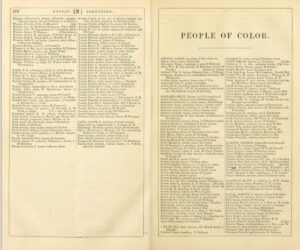
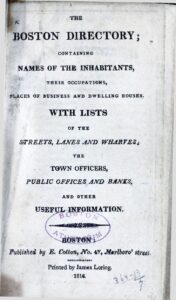 The Boston Directory first appeared in 1789. It was published irregularly until 1825, when it became an annual publication. The title page promised “A List of the Merchants, Mechanics, Traders, and others of the Town of Boston; in Order to enable Strangers to find the Residence of any Person.” Over time, the format became uniform with public offices listed in front, residents in the middle, and businesses at the end. Until 1816, only white residents were listed. In that year, for the first time, “Africans” were listed in their own section. By cross referencing this list with church records, the search reveals that a good many of these residents attended Trinity Church.
For instance, church records show that on April 16, 1817, Jane Alexander witnessed the baptism of Mary Anne Davis, a Black adult. Alexander lived on Belknap Street as did 67 other “Africans” in the directory. Belknap Street in Boston—which was renamed Joy Street later in the 19th century—was the 19th-century heart of Boston’s free Black community on Beacon Hill, and a vital center for the American abolitionist movement. In 1820, Jane Alexander married John White, who also appears in the directory.
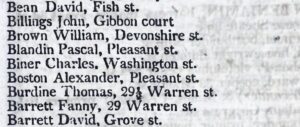 Thomas Burdine was baptized at Trinity in 1789. Two years later he, along with Prince Hall, witnessed the baptism of Joseph Hicks. In 1810, Burdine witnessed the baptisms of Frances Vanvactor and his son Charles. Burdine lived on Warren Street; Hicks lived on on Southac Street; and Vanvactor lived on Gibbons Court, an alleyway located off Washington Street.
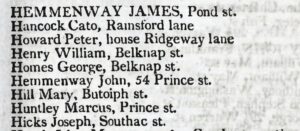 James Hemmenway was baptized at Trinity in 1812, and his son, William, was baptized two years later. Cato Hancock, a formerly enslaved servant of John Hancock, married Nancy Faddy at Trinity in 1791. Four of their children were baptized in the church between 1798 and 1803.
The 1848-49 edition of the Directory was the last to segregate people of color. The listings were much more detailed indicating where people lived, worked, and on occasion, marital status. The Directory provides a wealth of information about the growing Black community, the diversification of employment and professions, and provides evidence of the migration of peoples from areas like the north slope of Beacon Hill to other parts of the expanding city.
It can take time to mine history, though the results can often be illuminating and inspiring. John St. Pierre lived on Southac Street and ran a successful clothing business. Dig deeper and you learn that he was also an abolitionist actively engaged in efforts to end Southern enslavement. He was a member of the New England Freedom Association, an organization founded by African Americans in Boston to assist fugitive slaves. He fought for the desegregation of schools, adding his name to a petition featuring “the most wealthy and respectable of the Blacks.” He died in 1851 at the age of 37. One of his young daughters, Josephine, would grow up to become one of the most significant social activists of her time, a legacy that would continue with her daughter, Florida Ruffin Ridley. Florida would be married by Phillips Brooks in her parents’ home on Beacon Hill, and later her younger brother would sing with the Trinity choirs for 57 years.
John Robinson, a tailor, of West Cedar Street and Caesar Gardner, a waiter, of Belknap Place must have been friends. They served as the baptismal sponsors for each other’s children. John Frederick Robinson and Edward B. Gardner were baptized at Trinity in 1833. Another Robinson would be baptized in 1836, Richard. Richard Robinson would serve with the 54th Massachusetts Regiment while Edward B. Gardner served with the 55th. They both made it home.
It is disturbing that people were segregated in Boston in a public resource like a directory. Be that as it may, such resources can be a useful tool for research and to help make visible those people who may not be represented in other ways.
Until next time,
Cynthia
Read all of the From the Historians here.
If you’d like to receive news like this from Trinity in your inbox, sign up at trinitychurchboston.org/emails
Sources and Further Reading
Boston African American National Historic Site: https://www.nps.gov/boaf/index.htm
Boston Directory 1816: https://archive.org/details/bd-1816
*People of Color: https://archive.org/details/bd-1816/page/227/mode/1up
Boston Directory 1848-49: https://archive.org/details/bostondirectory4849bost/page/n8/mode/1up
*People of Color: https://archive.org/details/bostondirectory4849bost/page/279/mode/1up
Meet Florida Ruffin Ridley: https://www.leventhalmap.org/digital-exhibitions/building-blocks/people/