
Dear Trinity Church and friends,
They are hard to see: tablets and plaques, hanging on the walls, most veiled by shadow much of the day. Some are made of white marble, pale sandstone, or slate. A few are metal, bronze, or brass. There are richly-colored marbles in red and green. Look closely. Some are simply decorated, just words. Most are ornate covered in imagery like pine boughs, oak leaves, and acorns, grape vines and a winged cherub or two. They were all given in memory of loved ones and to those who served the parish in some meaningful way.
One memorial made headlines, “Tablet to Dr. Leverett Bradley Will Be Unveiled in Trinity Church on Monday.” Designed by Sarah Wyman Whitman and made by John Evans and Sons, the tablet was commissioned by Whitman’s friend and fellow artist Susan Hinckley Bradley in memory of her husband Leverett Bradley. Bradley began his long liturgical career as the first assistant minister for Phillips Brooks in 1878 before answering the call to other parishes.
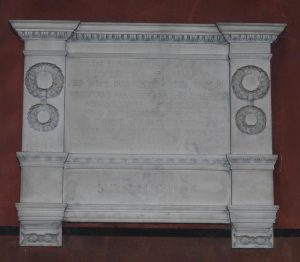
The memorial, with Whitman’s signature wreaths, is made of white Carrara marble, and at the bottom, above a floral half band, there is a motto, “Sursum Corda,” meaning, “Lift Up Your Hearts.” One journalist remarked that “the white marble is in striking contrast to the rest of the interior of the church, the walls and most of the other tablets being dark, and its inscription is visible quite a distance.” At the time, the memorial was located on the east wall of the north transept.
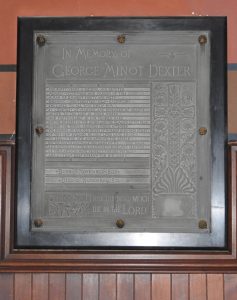
Henry Hobson Richardson designed this tablet (below) in memory of George Minot Dexter. The original intention was to have Augustus Saint-Gaudens sculpt Dexter’s visage on the tablet, but in the end, there are “simply” the words speaking to his character. As a long-time member of the parish and member of the Building Committee, Dexter approved of the plans for a new church to be built in the Back Bay, but he did not live to see it completed. He is remembered by both the tablet and a stained-glass window, David’s Charge to Solomon, located in the baptistery.
In addition to Richardson, two other architects designed tablets. A native New Englander, architect Joseph Everett Chandler attended M.I.T. and apprenticed with McKim, Mead & White among others. A proponent of Colonial Revival architecture, he is most widely known for overseeing the restoration of the Paul Revere House, the House of the Seven Gables and the Isaac Royall House. In 1908 he was commissioned to design a memorial for Charles Henry Parker. It was made by John Evans and Son.
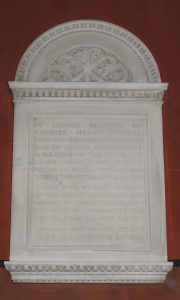
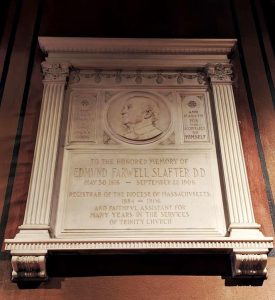
The second architect, Guy Lowell, was a member of the well-known Lowell family. His studies took him from MIT to the Ecole des Beaux-Arts in Paris. He was the architect for the first Charles River Dam. As part of the dam’s construction, Lowell was responsible for the landscape design of the Boston Embankment, now known as the Esplanade. He is especially famous for designing Boston’s Museum of Fine Arts. Around 1906 he designed a tablet in memory of Edmund Farwell Slafter. Slafter was ordained at Trinity Church by Bishop Manton Eastburn in 1844 and was very active in the Episcopal Diocese. In 1872, Phillips Brooks asked him to help administer Holy Communion during services, which he did until the end of his life in 1906.
Of all the memorials upon the walls, there is just one that predates the building. It hung on the wall of the church on Summer Street. With some intervention, it survived the Great Fire of 1872. In November 1872, downtown Boston lay in ruins. That night four men entered the church to take stock of the devastation.
A decade later, a parishioner with the initials A. B. E. shared in the Boston Evening Transcript:
“We four were the last occupants of the building. I remember that Mr. Brooks ascended into the pulpit and said, ‘This is the last of old Trinity,’ or words to that effect. A pew door was torn from its hinges, the tablet wrenched from its resting place and Gardiner and I carried it on this support through the crowded streets – Summer, Winter and Tremont streets – to the grass plot in front of St. Paul’s Church.”
In addition to this person, at Brooks’s side were Richard Dillon the sexton and Edward G. Gardiner. Gardiner was the great grandson of Rector John Sylvester John Gardiner to whom the tablet was dedicated.
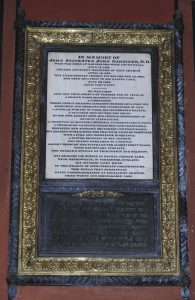
Where the marble tablet was kept until the new Trinity Church could be built is unclear. In time, a new frame was completed. And what a frame composed of cast iron and brass with an inner bronze plaque at the bottom describing the upper section’s rescue from the fire.
In 1888, just eleven years after the consecration of the Back Bay building, Arthur Herbert Chester completed Trinity Church in the City of Boston: an Historical and Descriptive Account, with a Guide to its Windows and Paintings. Chester, who was just 20 years old, wrote that the tablet hung on the chancel wall. In Chester’s account there were only a few tablets in place at the time, so the Gardiner tablet must have stood out. At some point the tablet was moved from the chancel to the south transept. Even when the interior lights are dim, the Gardiner tablet stands out in the shadows.
In 1940, as he was stepping down as long-time Vestryman and Warden, Robert Treat Paine III typed a six-page letter. It begins
“You may perhaps not fully appreciate what an exceedingly happy time I have had during all these years and how I have enjoyed the work. … I was necessarily obliged to undertake and look into many things. Since then, at one time or another, I have meddled with about every side of the church’s life, but especially the structural side. …”
He proceeds to give an overview and update on just about everything structural at the church including memorial tablets.
He makes clear that he had worked hard
“to have the vestry adopt a policy that no memorials should be placed on the walls except in connection with those who had rendered distinguished and unusual service to the church, and that such memorials be of such nature and appearance that they would blend harmoniously with the architecture and color scheme of the church. A glaringly white marble tablet, too flauntingly facing the congregation from the east wall of the north transept was moved away to the north wall to join the other ghastly stone.”
Clearly a man of strong opinion!
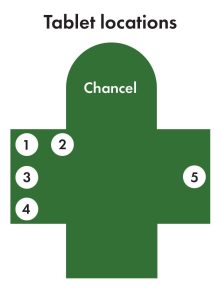
Between the sanctuary, narthex, parish house, and various nooks and crannies of the building there are roughly more than twenty memorials hanging on the walls. See what you can discern the next time you are walking through the space. To help you get started, I’ve included a map of the tablets mentioned above.
Until next month,
Cynthia
Sources and Further Reading
Bigelow, R. P. Edward Gardiner Gardiner (1854-1907) Proceedings of the American Academy of Arts and Sciences, Vol. 74, No. 6 (Nov. 1940) pp. 124-126. https://www.jstor.org/stable/20023373
Chester, Arthur H. Trinity Church in the City of Boston: an Historical and Descriptive Account, with a Guide to its Windows and Paintings. Cambridge: J. Wilson and Son. 1888. p. 32-33. https://archive.org/details/trinitychurchinc00ches_0
Everett, William and William Lawrence. Memoir of Rev. Edmund F. Slafter, D. D.
Proceedings of the Massachusetts Historical Society, Second Series, Vol. 20, [Vol. 40 of continuous numbering] (1906 – 1907), pp. 587-596. https://www.jstor.org/stable/25078051
Bradley Tablet in Trinity. Boston Herald, May 9, 1905, p. 8.
Notes and Queries. Boston Evening Transcript. July 7, 1894. Boston, MA. p.7.
Notes and Queries. Boston Evening Transcript. July 21, 1894 Boston, MA, p. 10.
Paine, Robert Treat Paine. Letter, 1940. Trinity Church Archives.