

Dear Trinity Church and friends,
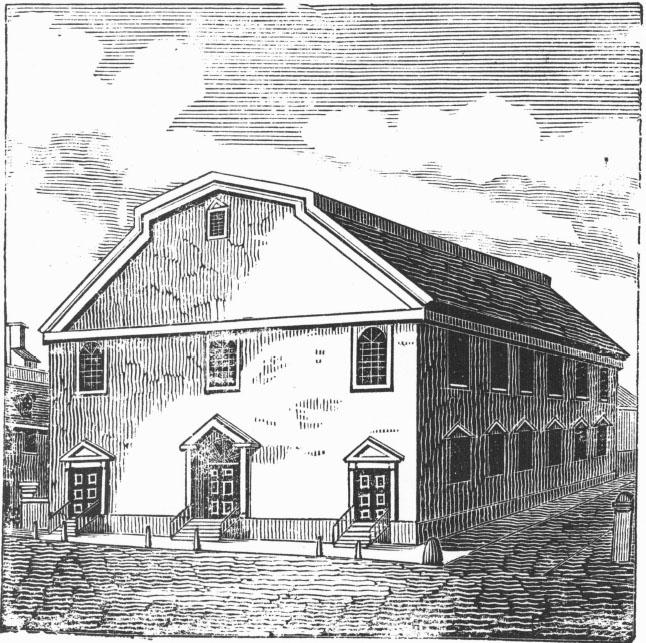
Trinity Church in the City of Boston, located in Copley Square, is the third building that the parish, founded in 1733, has called home. The first building was constructed in 1734 in downtown Boston on Summer Street. The wood building “was 90 feet long, and 60 broad, without any external adornment. It had neither tower nor steeple, nor windows in the lower story of the front. There were 3 entrances in front unprotected by porches. …” Nearly sixty years later, the parish sought to rectify that absence.
At a vestry meeting on April 7, 1793, church wardens and other vestry members voted that vestrymen Samuel Smith and Jabez Hatch procure plans for a porch or portico with a colonnade for the south end of the church. They were given two weeks to produce the plan and its cost. At a meeting held on the evening of April 28, Smith and Hatch presented the plan. The plan was unanimously well-received, but not the cost, an estimated three thousand dollars. Deemed too much to easily raise, the vestry voted to temporarily set aside constructing a porch.
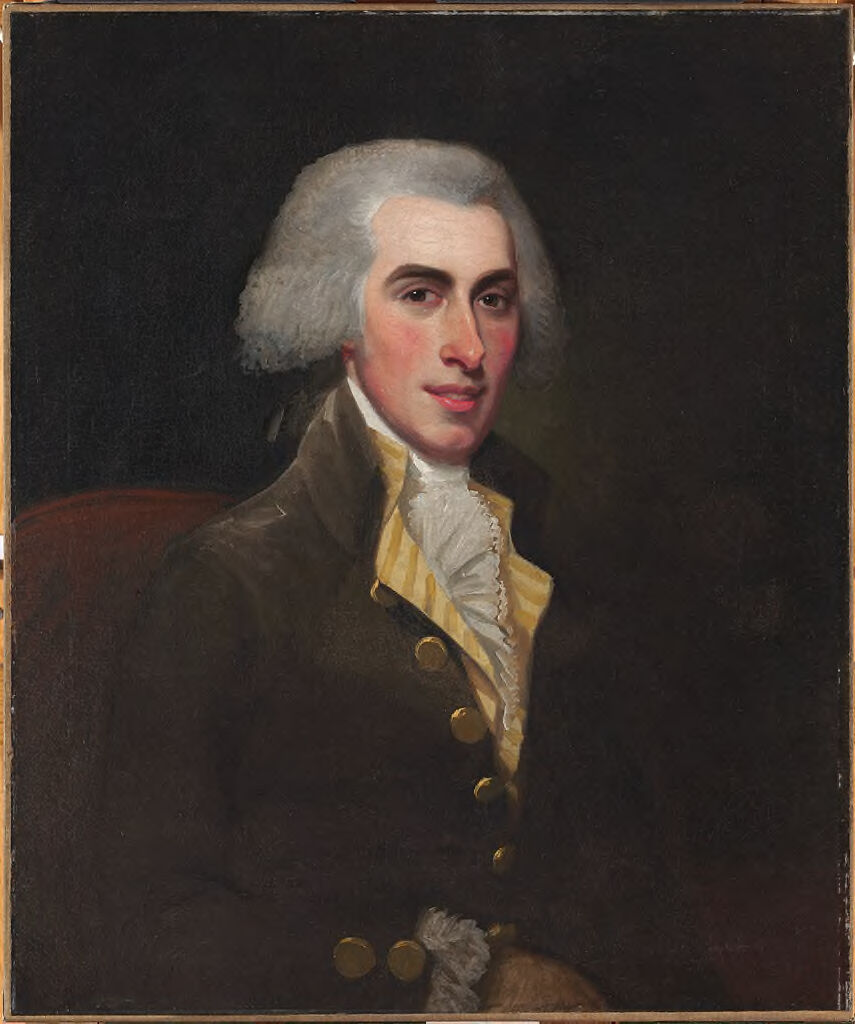
Before the meeting’s end, they also voted that thanks be given to Smith and Hatch “for their zeal and attention” in gathering the information, and that the wardens make suitable returns to architect Charles Bulfinch for his elegant and much-admired plan. Bulfinch, who in 1788 had wed at Trinity and whose children were subsequently baptized there, refused to accept any payment for his work.
Nearly a decade later, the idea of a porch still resonated within the parish. At a vestry meeting in 1801, the wardens along with vestryman Samuel Smith formed a committee to develop a new plan. On April 25, the committee shared their proposal for a brick porch. Again, the endeavor was deemed too expensive, especially since the state of the Summer Street building “would not warrant any new Addition … and that it would be more advisable to devise ways & means to build a new Church.”
On January 13, 1828, the vestry gathered. After debate the following passed unanimously: “Whereas several causes exist which make it desirable that the present old & combustible edifice of Trinity Church should be taken down and replaced by a new and more safe & comfortable building; and whereas the prosperity and revenue of the Church will probably be increased by enlarging the place of public worship, especially at this time when the Trustees of the Greene Foundation are about to appoint an Assistant Minister in the Church: Therefore Voted, That the Wardens be directed to call a Proprietors’ Meeting …”
Proprietors, those who purchased or rented pews in the church, included some of the most powerful and wealthy individuals in New England. At that gathering, the proprietors agreed to the erection of a new building and that committees should be formed
- to determine compensation to current pew holders for surrendering their pews in the “old” church;
- to decide where the congregation would worship during the interim;
- to form an official Building Committee; and
- to determine how funds would be raised and then repaid at the completion of the project. The committees quickly formed.
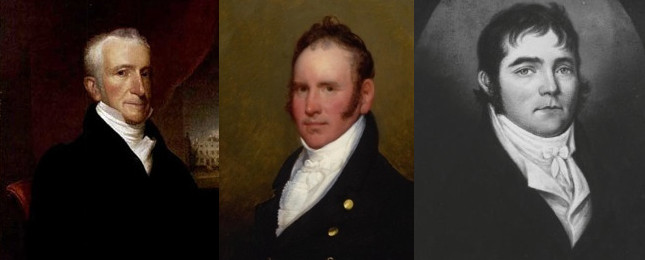
Gardiner Greene, Jonathan Amory and Joseph Tilden
Vestrymen Charles Apthorp, John Hubbard, Joseph Head Jr., and William Dehon were tasked with acquiring a plan for the new building. Gardiner Greene, Jonathan Amory, and Joseph Tilden formed a committee to consider and report what compensation should be made to pew holders for surrender of their pews to the church and to propose where the money should come from.
Joseph Head Sr., George Brinley, and Wm. D. Sohier were to consider, among other tasks, where the congregation would worship during construction. Massachusetts Lieutenant Governor Thomas L. Winthrop, Thomas Perkins, and William Dehon formed a committee to consider and report how funds were to be raised and repaid for rebuilding the church. Henry Hubbard and Samuel Hale Parker formed a committee to determine the best manner of disposing of the old church building. All reports and recommendations from these committees were due January 30, 1828.
Once received, the recommendations were quickly enacted. A call to proprietors to help fund the construction of the new church was answered. By February 1828, merchant James Perkins, brother of Thomas Handasyd Perkins, and wife Sarah loaned the church a combined five thousand dollars. Gardiner Greene and John Hubbard loaned three thousand dollars each. Church records show that they were among at least thirty-three proprietors who loaned money to the church and pledged to purchase pews in the new building provided that those pews could be bought at fair value and the new edifice be completed in two years.
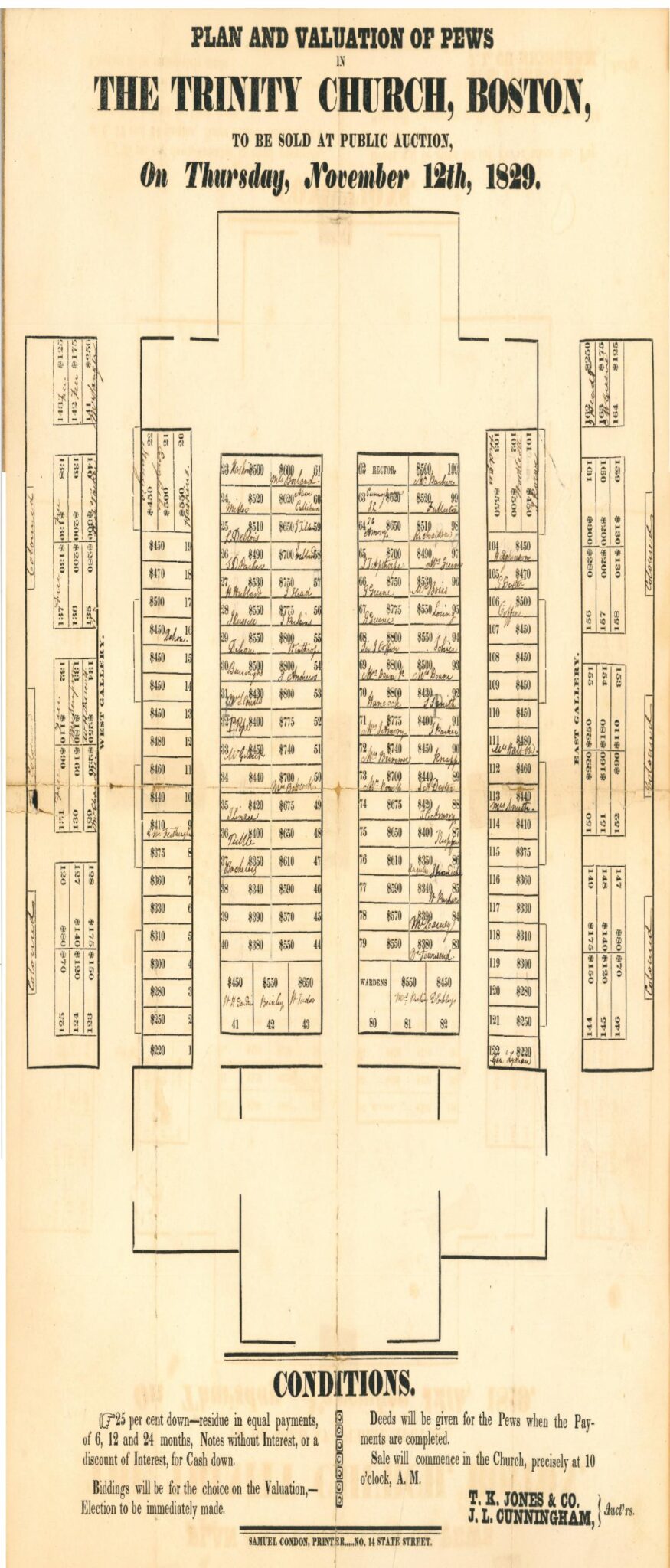
The vestry appointed three appraisers to value the pews: William Appleton of St. Paul’s Church, John Rice of Christ Church (Old North), and Edward H. Robbins of Trinity Church. Pews in the new building would be on the ground level as well as gallery seating. Once the current proprietors were allowed to purchase their pews at a reasonable rate, the remainder were to be auctioned.
Vestrymen Charles Apthorp, John Hubbard, Joseph Head Jr., and William Dehon were tasked with acquiring a plan for the new building. Gardiner Greene, Jonathan Amory, and Joseph Tilden formed a committee to consider and report what compensation should be made to pew holders for surrender of their pews to the church and to propose where the money should come from.
Joseph Head Sr., George Brinley, and Wm. D. Sohier were to consider, among other tasks, where the congregation would worship during construction. Massachusetts Lieutenant Governor Thomas L. Winthrop, Thomas Perkins, and William Dehon formed a committee to consider and report how funds were to be raised and repaid for rebuilding the church. Henry Hubbard and Samuel Hale Parker formed a committee to determine the best manner of disposing of the old church building. All reports and recommendations from these committees were due January 30, 1828.
Once received, the recommendations were quickly enacted. A call to proprietors to help fund the construction of the new church was answered. By February 1828, merchant James Perkins, brother of Thomas Handasyd Perkins, and wife Sarah loaned the church a combined five thousand dollars. Gardiner Greene and John Hubbard loaned three thousand dollars each. Church records show that they were among at least thirty-three proprietors who loaned money to the church and pledged to purchase pews in the new building provided that those pews could be bought at fair value and the new edifice be completed in two years.
The vestry appointed three appraisers to value the pews: William Appleton of St. Paul’s Church, John Rice of Christ Church (Old North), and Edward H. Robbins of Trinity Church. Pews in the new building would be on the ground level as well as gallery seating. Once the current proprietors were allowed to purchase their pews at a reasonable rate, the remainder were to be auctioned.
On Sunday August 3, 1828, Holy Communion was administered in the old church for the last time by Assistant Minister Reverend George W. Doane. Notice was given that the congregation, during the rebuilding of the church, would assemble at Boylston Hall in Boylston Market, designed by Charles Bulfinch.
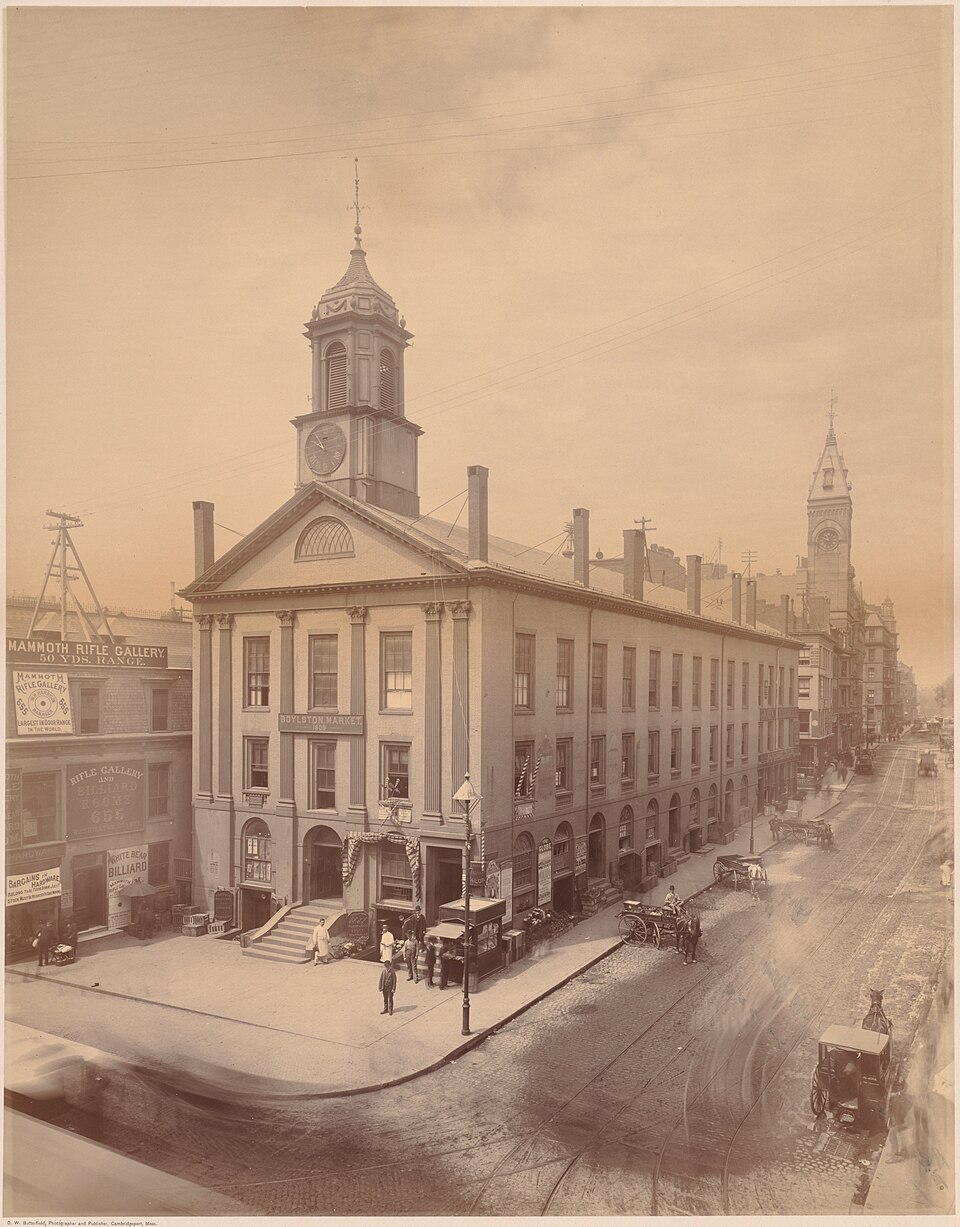
On August 31, 1828, at a meeting of the proprietors held in Boylston Hall, it was voted that the “Wardens of Trinity Church be authorised & are hereby authorised, to obtain the use of Boylston Hall from the Handel & Hayden Society for the use of the Proprietors of Trinity Church during Sundays, Good Friday, Ash Wednesday, Christmas, Fast & Thanksgiving days, at a Rent not exceeding $400 per annum or in that ratio until Trinity Church is rebuilt or ready for occupancy. The expense of Fuel to be paid by the Handel & Hayden society.”
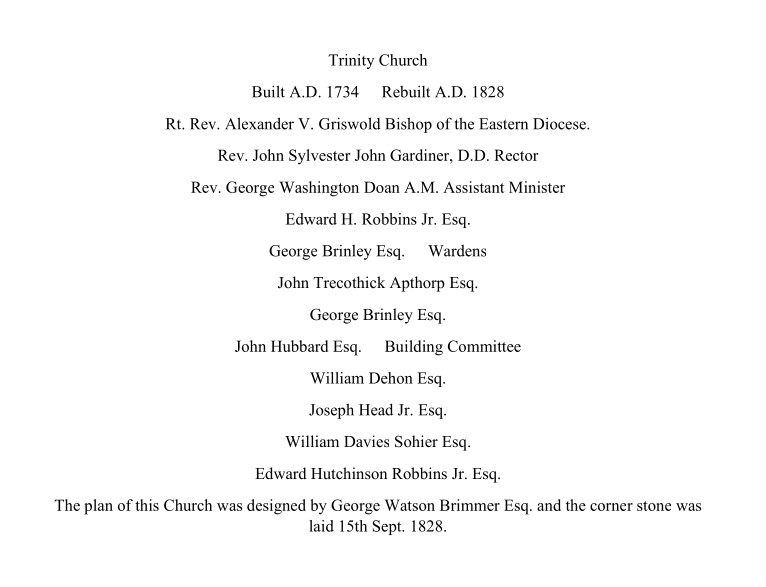
On September 15, 1828, the cornerstone of the new church was placed. Rev. Doane delivered a prayer composed for the occasion while standing upon the stone before it was laid. The Rector Rev. Dr. Gardiner read a copy of the inscription (shown below) engraved on the silver plate deposited beneath the stone. In addition to the silver plate, also deposited were five silver dollars, four copper coins, and editions of two newspapers, the Columbian Centinel and the Episcopal Watchman.
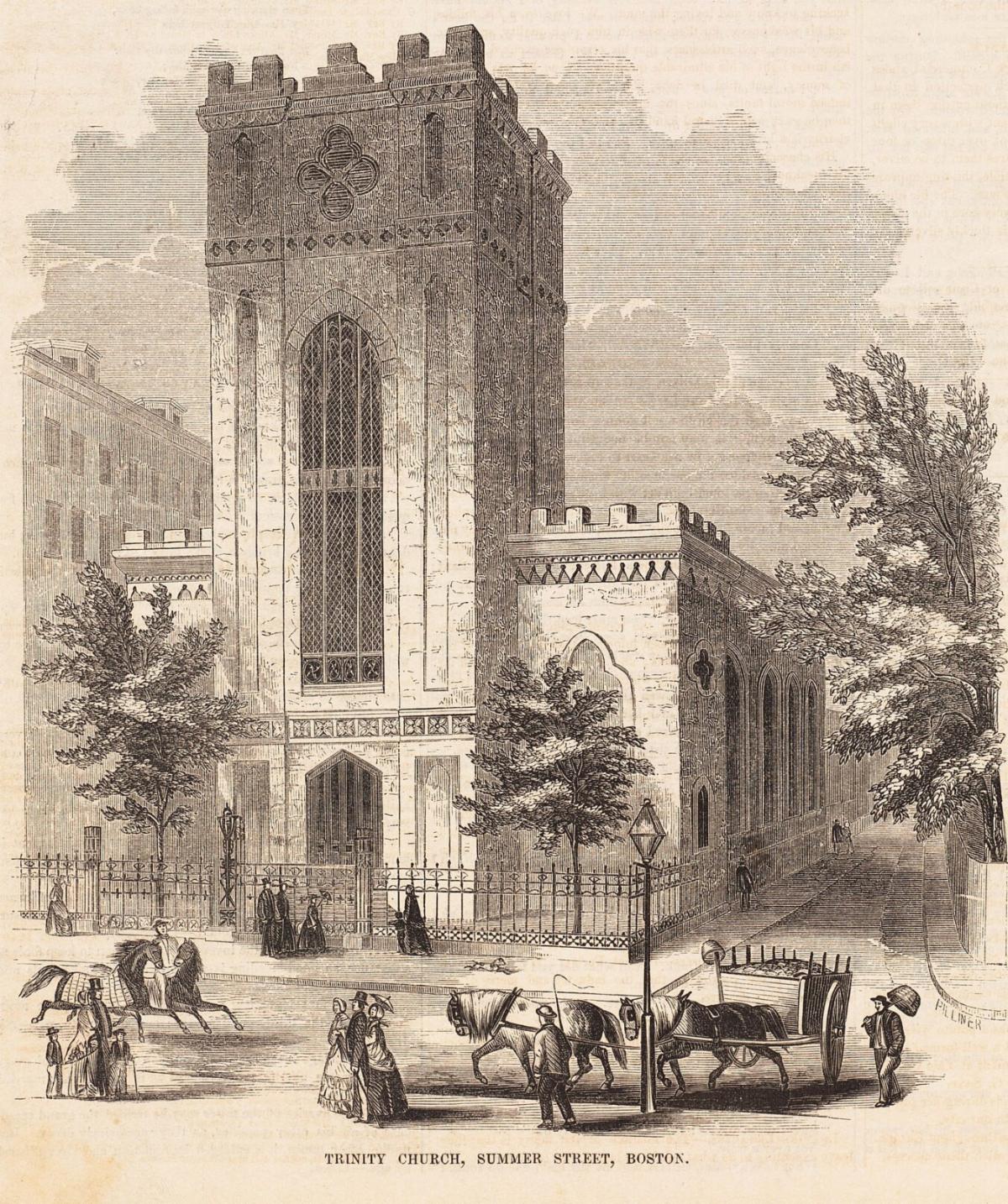
On November 11, 1829, the new Trinity Church on Summer Street was consecrated. For the next 43 years the parish would call the “massive temple of rough hewn granite” home. Its Gothic Revival style would inspire the design of many other New England churches.
During those 43 years downtown Boston changed. Once surrounded by residential estates, the church became surrounded by commercial enterprises.
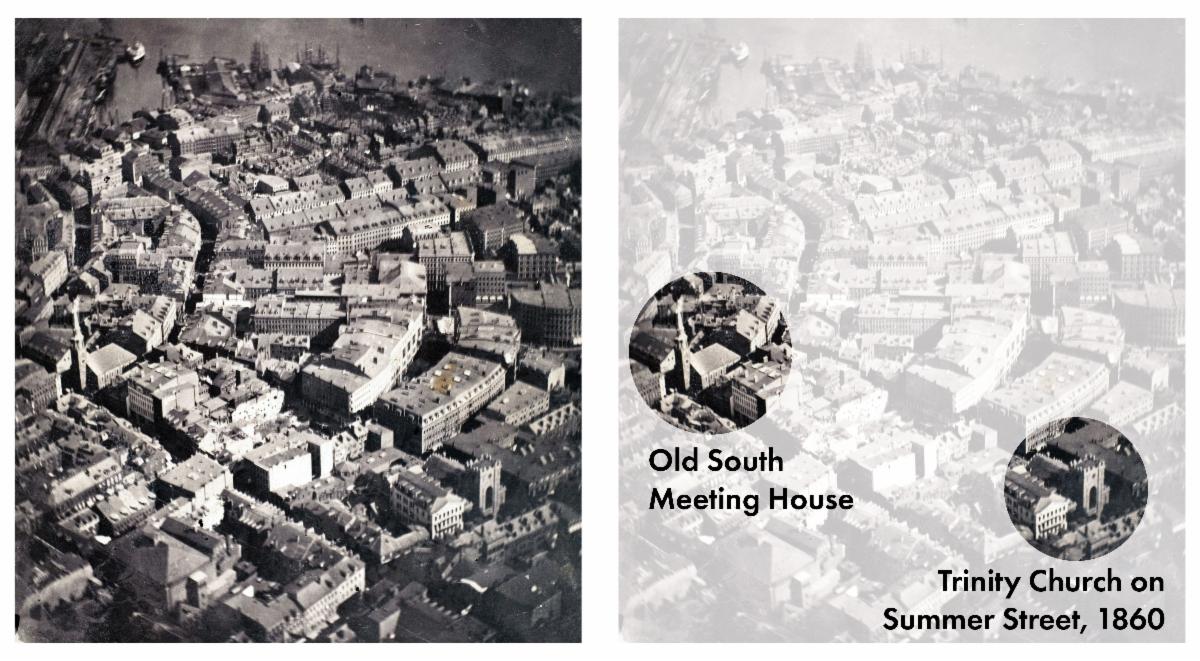
 By the time, in 1869, Reverend Phillips Brooks was called as Rector, the parish was ready for a change. Parishioners were moving to different parts of the city. In 1870, the church purchased land in a newly created area called the Back Bay where many of its parishioners were moving. It was a timely investment.
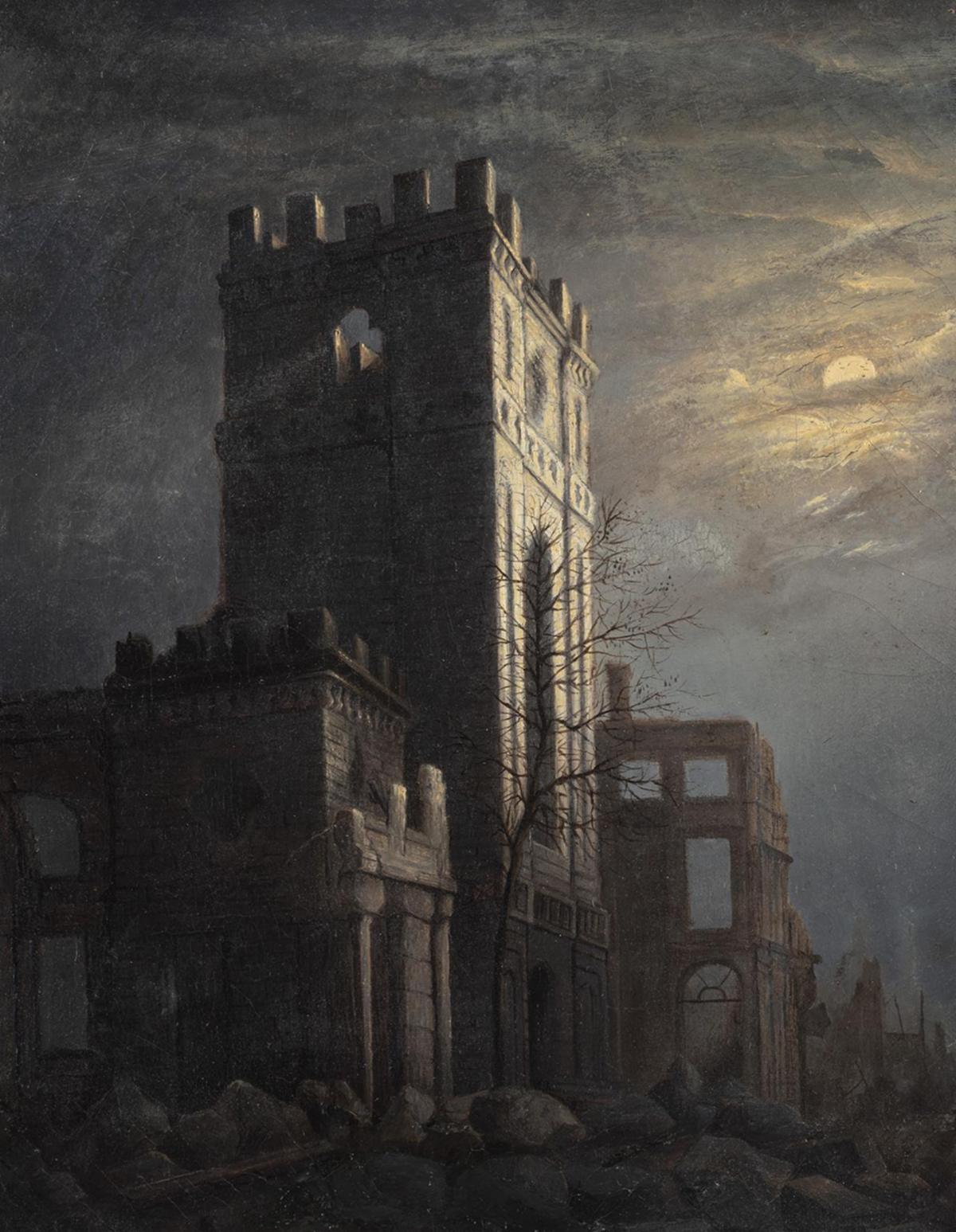
On November 9, 1872, a Great Fire broke out in downtown Boston consuming 65 acres and 776 buildings, including Trinity Church. The congregation’s time on Summer Street was over. But in just five years, a new home would rise, a building with many doors, and later a porch, all designed and decorated with the intent to shelter and welcome all.
Until next time,
Cynthia
See all of the From the Historians here.
Sources and Further Reading
Edwin M Bacon. Washington Street, old and new : a history in narrative form of the changes which this ancient street has undergone since the settlement of Boston. Boston : Macullar Parker Co., 1913.
Roger G. Reed. Building Victorian Boston: the architecture of Gridley J.F. Bryant. Univ of Massachusetts Press, 2007; p.20.
Trinity Church Guide Book, 2016.
Vestry Minutes, 1739-1829 found in Oliver, Andrew and James Bishop Peabody, ed. The Records of Trinity Church 1728 – 1830. Published by the Colonial Society of Massachusetts. 1980. https://www.colonialsociety.org/node/1090#ch04
Great Boston Fire https://en.wikipedia.org/wiki/Great_Boston_Fire_of_1872
A Few of the People
Charles Apthorp – https://en.wikipedia.org/wiki/Charles_Apthorp
Charles Bulfinch – https://en.wikipedia.org/wiki/Charles_Bulfinch
Gardiner Greene – https://en.wikipedia.org/wiki/Gardiner_Greene
John Hubbard – https://www.spanglefish.com/slavesandhighlanders/index.asp?pageid=561955
Samuel Hale Parker – https://en.wikipedia.org/wiki/Samuel_Hale_Parker
James Perkins – https://cdm.bostonathenaeum.org/digital/collection/p16057coll43
Joseph Tilden – https://americanaristocracy.com/people/joseph-tilden-1
Image Sources
Trinity Church Building #1
Drake, Samuel Adams. Old Landmarks and Historic Personages of Boston. Little, Brown, and Company. Boston, 1900. p. 386.
Charles Bulfinch
https://harvardartmuseums.org/collections/object/299910
Boylston Market
https://www.digitalcommonwealth.org/search/commonwealth:7s75dj90s
Trinity Church Building #2
Boston Pulpit No. 19 Trinity Church. Gleason’s Pictorial. November 5, 1853, Volume 5, Number 19, p. 12.
Sterograph. Boston Public Library Derivative Work. https://en.wikipedia.org/wiki/Trinity_Church,_Boston_(Summer_Street)#/media/File:TrinityChurch_SummerSt_Boston.jpg
Boston, as the Eagle and the Wild Goose See It
Black, James Wallace. 1860. Derivative Work. https://www.massmoments.org/moment-details/balloonist-takes-first-aerial-photograph.html
Plan and Valuation of Pews for Auction, 1829. Trinity Church Archives.
Trinity Church Destroyed by the Great Fire, a painting by parishioner Sarah Wyman Whitman. Trinity Church Archives.